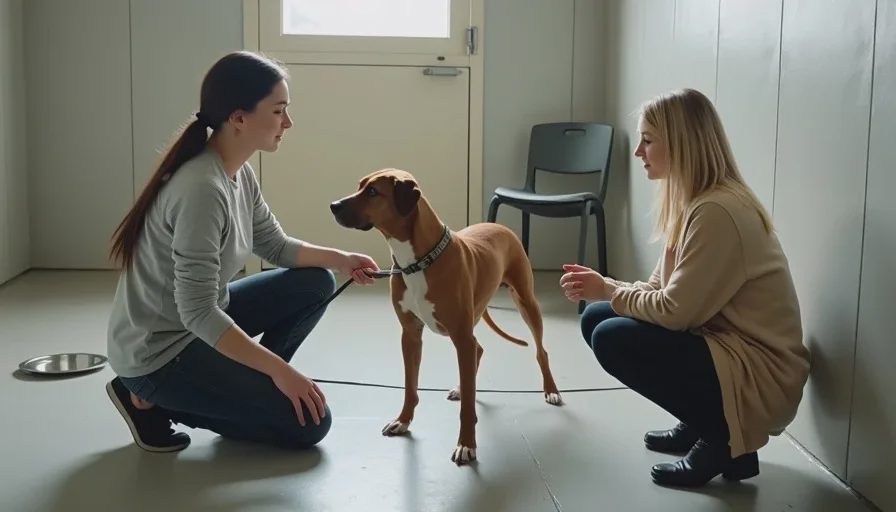
Meeting a shelter dog for the first time can feel like a blind date with fur and a leash. You want it to go well, the dog probably wants it to go well, but neither of you speaks the same language. I've sat through dozens of meet-and-greets as a volunteer, and I can tell you this: most people spend the whole time looking at the wrong things. They watch the tail. They listen for growls. They wait for the dog to "warm up." But how to read a dog in 10 minutes is not about spotting obvious signs. It's about noticing what the dog is telling you with their whole body before they ever get close enough to say anything.
A meet-and-greet is not a pass-fail test. It's a snapshot. Ten minutes in a shelter meeting room won't tell you everything about a dog, but it can tell you a lot if you know where to look. Here's what I've learned from being the person holding the leash on both sides of those ten minutes.
First Impressions Matter, but Not the Way You Think
The first thing most people do when they see the dog is look for happiness. Is the dog wagging? Is the dog coming toward them? Does the dog look excited? Those things matter, but they're only a small piece of the picture. A dog who charges at the gate with a frantically wagging tail is not necessarily friendly—they might be overstimulated and about to redirect all that energy into jumping, mouthing, or worse. A dog who stays at the back of the kennel and won't approach is not necessarily unfriendly—they might be terrified, and terror can look like a lot of things.
What I watch first is not the tail. It's the whole body. Is the dog's weight balanced or braced? Are the ears neutral or pinned back? Is the mouth soft or tight? These small signals tell me what kind of emotional state the dog is in before any interaction begins.
The First Minute: Watch Before You Enter
Before you even step into the meeting room, stand outside the door or on the other side of the gate and just watch. Don't call the dog's name. Don't tap the glass. Don't make kissy sounds. Just observe.
Body posture and weight distribution
A relaxed dog stands with weight evenly distributed, head level, body loose. A nervous dog may lean back, shift from paw to paw, or freeze in place with stiff legs. A dog who approaches the gate with a low, wiggly body and a soft face is showing social interest. A dog who approaches with a stiff, upright posture and a hard stare is showing something else—confidence, sure, but possibly the kind that doesn't like being challenged.
I once watched a meet-and-greet where the dog stood at the gate with a perfectly still body and a slowly wagging tail. The adopter thought it was friendly. I saw a dog who was unsure and holding itself together. That dog needed more time before being touched. We gave it another ten minutes, and it relaxed enough to sniff a hand. The body language was there all along.
The face: eyes, mouth, ears
A soft, relaxed eye with normal blinking is a good sign. A wide eye with visible whites—called whale eye—is often a sign of stress. A tightly closed mouth can mean tension, especially if the tongue flicks out quickly. Ears pulled back flat against the head are fear. Ears slightly back but relaxed, with a soft face, can just mean the dog is taking things in.
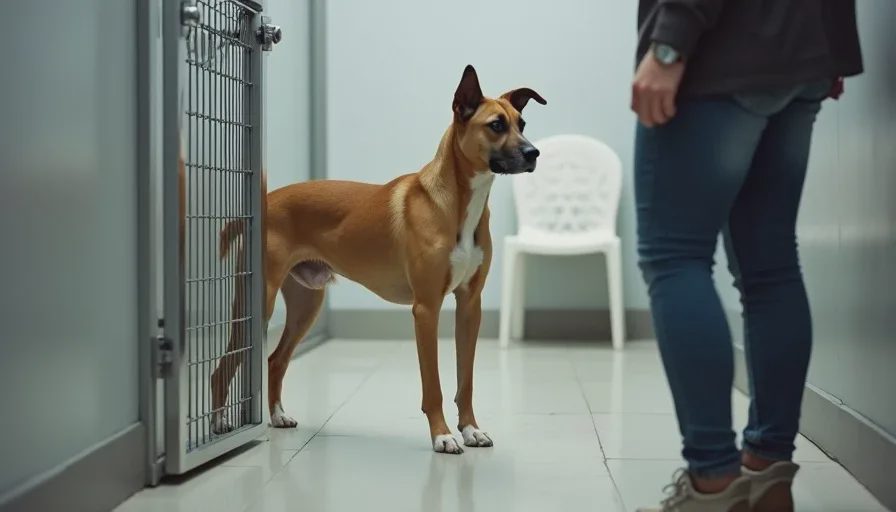
None of these signals mean anything on their own. You're looking for a cluster. A dog with a loose body and soft eyes is fine, even if the tail isn't wagging. A dog with a wagging tail but stiff legs and a hard mouth is telling you something different. The body is the whole story.
Minute Two to Five: Enter the Space (Slowly)
When I bring a potential adopter into the meeting room, I tell them to do the same thing I do: enter slowly, keep your body turned slightly to the side, and don't reach for the dog right away. Let the dog decide the pace of the first approach.
How to approach without overwhelming
Don't loom over the dog. Crouch down or sit on a bench, keeping your body angled away. Avoid direct eye contact at first—staring can feel like a threat. Let the dog come to you. If they do, offer the back of your hand at their nose level, not the top of their head. A dog who sniffs and then turns away is not rejecting you. They're gathering information. A dog who sniffs and then leans in for more contact is showing interest.
Red flags that aren't actually red flags
Some behaviors scare people in a meet-and-greet when they're actually normal. A dog who yawns, licks their lips, or sniffs the ground is showing displacement behaviors—ways of coping with mild stress. They don't mean the dog is dangerous. They mean the dog is thinking. A dog who turns their head away when you reach for them is not being stubborn. They're asking for a little more space. If you back off, they'll often re-approach when they're ready.
I've watched adopters panic because a dog didn't want to be petted in the first five minutes. That's not a failure. That's a dog with boundaries. The dogs who set boundaries clearly are often easier to live with than the ones who shut down and tolerate anything.
Minutes Five to Ten: Interaction and Response
By the second half of the meet-and-greet, the dog has had a chance to process your presence. This is when I watch for how the dog responds to interaction—not just whether they allow it, but how they recover from it.
The treat test and consent checks
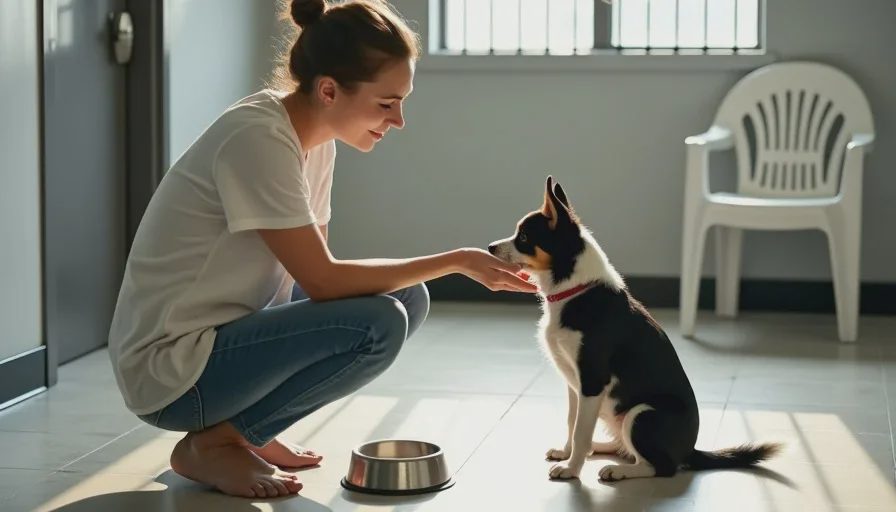
One of the simplest things I do in a meet-and-greet is offer a few small treats. I don't hand them directly at first. I toss one a little away and see if the dog goes for it. A dog who takes food is usually not in full panic mode. A dog who refuses food might be too stressed to eat, or might not be food-motivated. Either way, it's information, not judgment.
Then I do a consent check. I pet the dog for two or three seconds, then stop and pull my hand back. What does the dog do? If they lean in, nudge my hand, or move toward me, they're saying they want more. If they freeze, look away, or move back, they're saying they've had enough. A dog who tells you "no" clearly is a dog you can trust to communicate. The ones who tolerate everything quietly are the ones I worry about later.
Reading avoidance and recovery time
If something startles the dog—a door slamming, another dog barking, a loud voice—I watch how long it takes them to come back to baseline. A dog who startles and recovers in a few seconds is showing good bounce-back. A dog who stays crouched and trembling for minutes needs a very different home environment. Neither dog is bad. They just need different things.
I remember a meet-and-greet with a small terrier mix who hid under the bench for the first six minutes. The adopters sat quietly on the floor, not pushing, and by minute nine she crawled out and sniffed the woman's shoe. That was the whole meeting. They took her home and gave her a week to decompress. She turned out to be a confident little dog who just needed to do things on her own time. The 10-minute snapshot, read correctly, told them exactly how to start.
What 10 Minutes Can't Tell You
I want to be honest about the limits of this. Reading a dog in 10 minutes doesn't reveal their whole personality. Some dogs shut down in shelters and show almost nothing until they've been home for a week. Others put on a big show at the shelter and then settle into something completely different on a couch. The meet-and-greet is one data point, not the whole story.
What it can do is help you decide if you want to move forward. If the dog approaches you, accepts touch, recovers from minor stress, and shows some interest in connecting, those are good signs. If the dog is too overwhelmed to interact at all, that doesn't mean "no"—it means "not today, and maybe not here." Some dogs need a calmer introduction or a different setting to show who they are.
A Final Piece of Advice
If you're nervous about your own meet-and-greet, remember that the dog is probably more nervous than you are. Your job is not to perform or prove anything. It's to pay attention. Watch the body. Offer choices. Respect the dog's pace. The best meet-and-greets I've ever seen were not the ones where the dog ran over and showered the person with kisses. They were the ones where both sides took their time, read each other's signals, and left the room with a little more trust than they entered with.
Every good dog was once someone's "too much."
And every good match starts with someone willing to read the dog in front of them—not the one they imagined.
Letters
No letters yet. Yours could be the first.