
I've been in rescue for twelve years, and I've said the phrase "adopt don't shop" more times than I can count. On T-shirts, on bumper stickers, in shelter lobbies, at adoption events. The slogan is everywhere, and I understand why. It's catchy. It rhymes. It points people toward a good thing. But here's what I didn't expect when I started saying it: for a lot of people, "adopt don't shop" is not an invitation. It's an accusation. And instead of bringing more families to rescue dog adoption, it's quietly pushing them away.
I've watched it happen in real time. A woman at a coffee shop sees my foster dog and says, "I've been thinking about adopting." Then she pauses, glances at her partner, and adds, "But we're not sure we're ready." Before I can answer, someone else at the table says, "Well, if you buy from a breeder, you're part of the problem." The woman's face closes. The conversation dies. And another potential adopter walks away feeling judged instead of supported.
That's the problem with slogans. They're too small for the weight we put on them.
How a Slogan Became a Shame Test
The original idea behind "adopt don't shop" was to raise awareness about shelter animals and encourage people to consider adoption before buying from a breeder or pet store. That's a message I believe in. But somewhere along the way, the slogan hardened into something else: a moral standard that divides people into "good" pet owners and "bad" ones.
The guilt starts before the application
I hear from potential adopters all the time who are terrified of doing it wrong. They worry their yard isn't big enough. They worry their work hours are too long. They worry the rescue group will look at their apartment and say no. And underneath all of that is a deeper fear: that they're not good enough to adopt a dog, and if they admit that, someone will tell them they should just go buy one instead.
That's the trap. The slogan tells people to adopt, but the culture around it often makes adoption feel like an exam you have to pass. If you can't pass, you're not allowed to have a dog at all. That's not a message that helps dogs. It just makes people lie about their situation or give up entirely.
The "adopt don't shop" pressure can backfire
I've known families who wanted a specific type of dog—a small dog, a hypoallergenic breed, a puppy with known health history—and they felt ashamed to say so in rescue circles. So they quietly bought from a breeder. Not because they didn't want to rescue, but because they didn't want to be lectured for having needs. The slogan that was supposed to steer them toward adoption ended up steering them away, and they took their guilt with them.
That's the part we don't talk about enough: shame doesn't create good adopters. It creates silent ones.
What "Adopt Don't Shop" Gets Right
I don't want to throw the whole idea away. There's a reason the slogan exists, and it's still true that millions of healthy, loving dogs and cats enter shelters every year. Many of them are exactly what a family is looking for, and adoption is often a wonderful choice. The problem isn't the encouragement to adopt. The problem is the assumption that every person who shops is selfish, and every person who adopts is doing it right.
It raises awareness
Without the phrase, many people wouldn't think about rescue at all. It has introduced countless families to the idea of shelter adoption. That's a real benefit.
It highlights a real problem
Puppy mills and irresponsible breeders cause real suffering. The slogan points at something worth changing. But awareness and accusation are different tools, and I think we've been using the wrong one.
Why Some People Choose Not to Adopt—and Why That's Their Business
The truth is, people have reasons for the choices they make. Some of those reasons are practical. Some are emotional. Some are medical. And none of them are improved by being called a bad person.
Specific needs are valid
A family with severe allergies may need a dog that doesn't shed much. A household with young children may want a dog with a known history around kids. An elderly person may need a small, calm dog that can be carried up stairs. These are not excuses. They're realities. Rescue can sometimes meet those needs, but not always. When it can't, a responsible breeder who health-tests and temperament-tests is not the enemy.
Past experiences matter
I've talked to people who adopted a dog with severe trauma and weren't prepared for it. They rehomed the dog and later bought a puppy from a breeder because they couldn't face another unknown history. I don't agree with every choice like that, but I understand it. And understanding people is how you keep them in the conversation instead of pushing them out of it.

The goal is a good home, not a pure decision
At the end of the day, what I want is for every dog to have a safe, loving home for life. How that happens matters less to the dog than whether it happens. A dog doesn't know if it came from a shelter or a breeder. It knows whether it's fed, warm, and safe. That's the outcome I care about.
What I Say Instead of a Guilt Trip
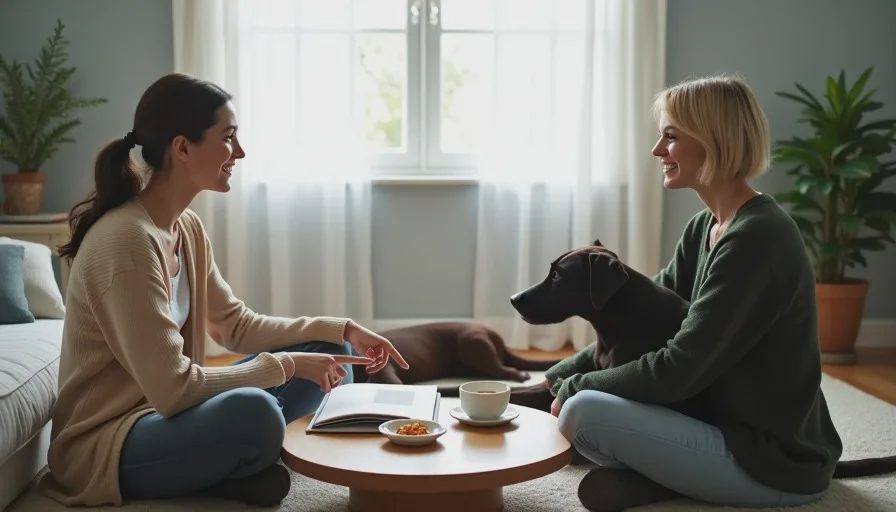
I've stopped using "adopt don't shop" as a conversation opener. Instead, I try to meet people where they are, because I've learned that people who feel listened to are more likely to consider adoption than people who feel attacked.
"Tell me about the dog you're looking for"
This question does something the slogan never does: it invites a real conversation. When someone describes their ideal dog—lazy, good with cats, okay alone for a few hours—I can often say, "You know, rescues have dogs like that. Let me show you." That's more effective than a bumper sticker.
"There's no perfect dog, but there might be the right one"
I tell people that rescue dogs aren't broken, but they also aren't blank slates. That's honest and reassuring at the same time. It lets people ask hard questions without feeling like they're failing a test.
"If adoption isn't right for you, I'm not here to judge"
This is the one that surprises people. Sometimes the person who expected a lecture relaxes enough to have a real conversation about their fears. And sometimes, by the end of that conversation, they're ready to look at a shelter dog. Not because I shamed them, but because I gave them space to be honest.
How to Talk About Adoption Without Pushing People Away
If you're someone who loves rescue and wants to encourage it, here's what I've learned about doing that without adding to the shame problem.
Share stories, not slogans
A specific dog with a specific story does more than a phrase ever could. When I talk about Waffles hiding behind the toilet, or Biscuit falling asleep in a sunbeam, people lean in. They can imagine themselves in that story. The slogan never gave them that.
Answer questions without judging the question
If someone asks, "What if the dog has behavior problems?" don't roll your eyes. Answer honestly. Then tell them what support looks like. The more you normalize hard questions, the less people will be afraid to ask them.
Let people choose adoption on their own timeline
Some people need to think for months before they adopt. That's okay. The dog doesn't need them to decide today. It needs them to decide well. Rushing someone into an adoption they're not ready for doesn't help the dog, and it doesn't help rescue.
Support the whole ecosystem
I support responsible breeders, shelters, and rescues at the same time. Not because I think all choices are equal, but because I think all good homes matter. A well-bred dog in a loving home is not a failure of rescue. It's just a dog in a loving home. And that's still something worth celebrating.
For the Person Who Feels Guilty
If you're someone who wants to adopt but is terrified of the process, or someone who shopped instead of adopted and carries guilt about it, I want to say this: you're not the problem. The problem is a system that makes people feel like they have to choose between being judged and being honest. You're allowed to have needs. You're allowed to have fears. You're allowed to take your time.
The dogs need homes. They don't need you to feel guilty while you look for one.
Every good dog was once someone's "too much."
And every good home starts with an honest conversation, not a slogan on a T-shirt.
Letters
No letters yet. Yours could be the first.